AI infrastructure for human flourishing.
Technology that disappears so connection can deepen.
Shunya (शून्य) — Sanskrit for "empty" · the fertile void from which all things arise
AI will soon outperform humanity at every cognitive task we've built civilizations around: analyzing, synthesizing, predicting, persuading, creating. That is not the biggest story of our time.
The bigger story is what becomes possible when the cognitive load lifts. For decades, a quieter human capacity has been neglected — awareness, presence, the intelligence that lives between people rather than inside any single mind. Social media colonized our attention. AI is now outsourcing our thinking. Both superpowers, under siege at once.
But hidden inside the crisis is an invitation. When machines handle more of the measurable, humanity is freed to develop what the Buddha once called the immeasurables: compassion, equanimity, loving-kindness, joy in others' flourishing. Not soft sentiments. The infrastructure of any community worth belonging to.
The market will not build this. Every major platform has followed the same gravitational arc: start free, extract data, serve ads. Google warned against it, then built it. Facebook promised against it, then pivoted. OpenAI said it would be dystopic, then announced it. The pattern is not hypocrisy — it is the physics of extrinsic motivation. Platforms that must capture attention structurally cannot build for its release.
So who builds technology designed to disappear? Who builds the infrastructure for what cannot be measured, optimized, or sold?
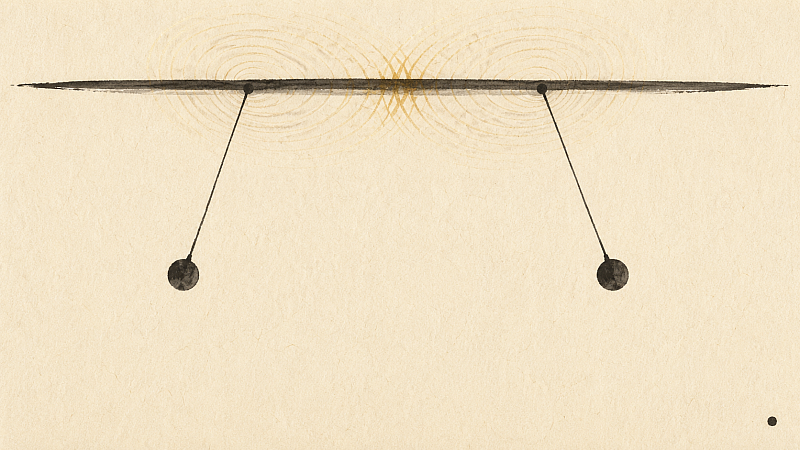
In 1656, the physicist Christiaan Huygens hung two pendulum clocks from a wooden beam. Within half an hour, the pendulums synchronized. He disturbed them. They re-synchronized. The coupling was not through the air. It was through the beam. The beam did not oscillate. It did not keep time. It merely transmitted — vibrations too subtle for the eye.
Most AI is designed to be the clock: it keeps time, gives answers, holds attention. We build technology designed to be the beam. Structurally essential. Experientially invisible. Tending the conditions under which people find each other — and then walking out of the room.
Huygens' empty cans don't set the beat — they allow the signal to travel. Every architecture carries a worldview. Ours carries emptiness: not the emptiness of absence, but the fertile void from which coherence arises.
AI does not replace the room. It lowers the cost of building the room — and then walks out of it. The technology fades. The room remains. And what happens in the room is the one thing that no technology can produce, purchase, or replace: the moment a group of human beings, attending to each other with their full presence, begins to think together in a way that none of them could think alone.
Community. Compassion. Compute power — in that order.
Every architecture carries a worldview. Ours carries emptiness — not absence, but the space from which trust emerges. We build platforms that draw out latent gifts without imposing a rhythm. Nothing is extracted. Everything given can compound.
AI shows up intensively at the beginning — matching, surfacing, mirroring the whole back to its parts — and fades as relationships deepen. By the time people are sitting together in a living room, the technology is a faint memory. The beam has done its work.
A crowd erases difference. A field metabolizes it. We design for the intelligence that lives between people — the deep-data field where new patterns of emergence arise. Not critical mass. Critical yeast: a few connected people with the capacity to help everything around them rise.
We are a small nonprofit AI lab. We build technology that deepens human connection and helps mission-driven organizations make the AI transition — at the one moment in history when they have a genuine chance to outpace commercial sectors.
Some of this work is paid. Much of it is offered freely. We are not building a brand. We are building a beam.
100+ AI companions spanning contemplative traditions — from meditation frameworks to interfaith scriptures to heart-intelligence research — serving tens of thousands of inquiries each month. Not chatbots. Wisdom mirrors.
AI that reads a thousand reflections and finds five people who share an unnamed question. It seeds small circles of strangers for real conversation — matching, coordinating, holding the logistics — then gets out of the way so something real can take root between humans.
AI-driven full-stack platform that scrapes, analyzes, curates, and distributes stories of human goodness — turning media consumption into connection, and viewers into participants.
Shared infrastructure, common tooling, and hands-on partnership to help for-good organizations harness AI without losing their soul. We build the platform layer so they can move faster than they could alone — at a fraction of the cost, with none of the extraction.
Our work grows from the soil of ServiceSpace — a 25-year, all-volunteer ecosystem of 600,000+ members in 100+ cities that has been running a living experiment: what designs emerge when you assume people want to give? No paid staff. No fundraising. No impact measurement. And yet: circles in a hundred living rooms, a million Smile Cards in circulation, retreats across 16 countries where most participants report it as one of the most transformative experiences of their lives.
That ecosystem imagined new social containers. We help existing organizations adopt them. Different mission. Same soil.
Shunya Labs operates as a program within The Pollination Project, an independent nonprofit foundation that supports grassroots changemakers worldwide. We have a small paid team, take on partnerships with aligned organizations, and offer much of our work freely — because the funding model shapes the product, and we need a model that can build for disappearance.
Non-commercial is not a moral badge. It is an engineering constraint. Different funding models produce different product incentives. If you don't want the same outcome, you can't use the same funding model.
If you're building something that matters — and you sense that AI should serve the room, not replace it — we'd love to explore together.
Get in touch