The Field · An Essay on the Third Leverage

Held

Markets gave us one kind of leverage. AI just handed us another. There is a third — older than both, and quieter than either. This essay begins in the market's language, and sheds it as it goes.

Tend the seed. Renounce the harvest. Trust the field.

Where does leverage come from?

Every era answers this question, and its answer shapes everything downstream — who gets to build, what gets built, and what the building does to the builder.

01

The Market

Capital compounds. Pool enough of it and a small team can move mountains — so long as the mountain can be priced. This leverage built the modern world, and it quietly redesigned the builders in its own image.

02

The Machine

AI has collapsed the cost of capability — a dividend of pure leverage, looking for a deposit account. Deposited into the market, it yields the solopreneur unicorn: one person, a billion-dollar valuation, historically unprecedented. More efficiency, compounding as more market.

03

The Field

The other deposit account. The same dividend, placed with beam mentality into the social field, compounds as trust and cultivates emergence: one person, disappearing into a web of relationships that sustains the work directly — the oldest leverage of all, and the least understood.

The first two are celebrated everywhere. The third barely has a name, because compassion's effect is distributed — across time, across people — and hence hard to quantify and impossible to monetize. But what can't be monetized can still be mobilized; whole lives have run on it. And here is the choice the machine age quietly sets before each of us: where you deposit the dividend determines what compounds.

A line, or a circle.

The standard story of progress is a line, and it is not wrong so much as hollow:

The line
technology creates material abundance scarcity diminishes love becomes easier

The trouble is the path itself. The road to that abundance strips away the very connection meant to enjoy it — so abundance arrives with no field to hold it, and what cannot be held cannot sustain or regenerate. A line must be fed from outside; it consumes its own container. But there has always been a second current, and it is not a line at all:

The circle
service invites inner transformation nature rewards it, immediately trust and connection deepen field intelligence emerges — the murmuration which regenerates more service

The last step feeds the first. The circle is auto-catalytic — it doesn't wait for the world to become abundant, and it doesn't leak; every turn of it thickens the very field that holds it. It begins with an act any person can make today, with empty hands.

The market's sacred geometry is the hockey stick.
Ours is the ensō.
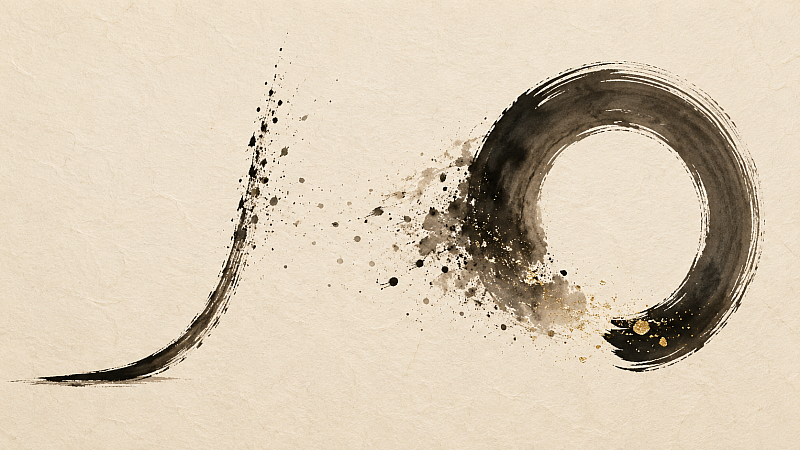
A rising line dissolving into an open ensō — the hockey stick becoming the circle

She wasn't funded. She was held.

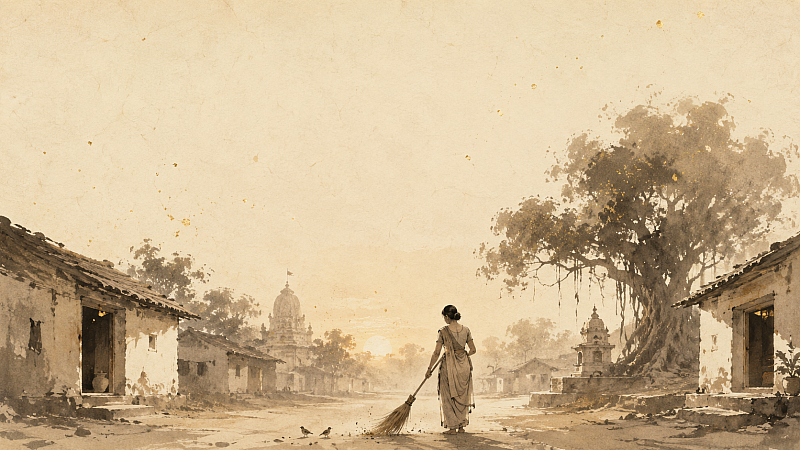
Vinoba Bhave, Gandhi's spiritual successor, would send workers into villages carrying three things: a broom, a book of wisdom, and a musical instrument. Service of the hands, the head, and the heart — nothing else in the pack.

Nirmala Deshpande once described arriving in South India that way: no money, no contacts, not even the language. She began by sweeping the roads. Because the service was unconditional, connections emerged; because connections emerged, the village made room for her — a corner of the temple to sleep in, a place at someone's meal. As her service deepened, so did the trust, and as she wove those relationships into new value for the community, a virtuous cycle took hold. Within a season, the village was transformed, and she walked on to the next one.

Instead of money, they were backed by nature. Money was happily used — but it remained a small slice of a much wider pie of value.

This was not an exception. From Peace Pilgrim walking penniless across America, to monastics on foot, to dozens of Gandhi's heirs across India — the pattern repeats wherever someone leads with unconditional service and lets the field respond.

A lone figure sweeping a village road at dawn — sumi-e ink on cream paper
· · ·

The current still runs.

It's fair to ask whether any of this survives contact with the present — vanishing commons, thin community ties, technologies that numb us to generosity's frequency. The honest answer: it looks different now, and works harder. But the current still runs.

During a family member's 73-day hospital stay, one of us began bringing homemade chai for the nurses — first to sustain a round-the-clock caregiving caravan, then as a small gift of gratitude. Flask after flask, the ward changed around it. And one morning, mid-recipe, the realization: the mint was from a cousin's backyard, delivered weekly; the milk from cartons Dad picked up; the spice mix a gift from friends in India; the lemongrass plucked by Mom's hands. So many hands in a single cup.

No one budgeted for that chai. No one invoiced for it. Yet it moved medicine no pharmacy stocks — and it was, unmistakably, held. The same mechanism as Vinoba's villages, running at the scale of a hospital room in California.

Circulation leads to increase.

In a gift ecology, goods and services move without strings — and it is the circulation itself that creates increase: more connection, more trust, more capacity. Walk into a Karma Kitchen and your bill reads zero, because someone before you paid it forward; you're simply trusted to keep the chain alive. Each such exchange shifts the ground a little — consumption toward contribution, transaction toward trust, scarcity toward abundance, isolation toward community.

Three things make this a genuine funding model rather than a nice sentiment. First, the work works on the worker — Gandhi asked everyone to spin thread not because the world needed thread, but because the spinner needed the spinning; inner transformation is the first return, and it arrives immediately. Second, trust is load-bearing infrastructure — a field with deep trust routes resources, information, and opportunity with an efficiency no contract can match. Third, many kinds of capital extend the runway — when a labor of love is held by relational, social, and spiritual capital alongside financial capital, its resiliency is afforded a far longer timeline, long enough for the virtuous cycle to kick in.

A market funds what it can measure. A field funds what it can feel.

· · ·

Generosity entrepreneurs.

More than a decade ago, ServiceSpace sketched a name for the people who work this way: generosity entrepreneurs. Entrepreneurs, because they take real initiative and real risk to create new value. Generosity, because they radically widen what counts as value — including their own inner transformation in the ledger, externalizing benefit the way older models externalized cost, and leaving gift ecologies in their wake.

That early sketch imagined an incubator for "compassion capital" — vocational schools amplify the hands, think-tanks the head, but no institution yet designs projects that lead with the heart. It also insisted on one countercultural rule: there's no application. Nominations can't be wired to ambition; the field itself, over time, recognizes and calls forward its own.

The idea waited. What it was waiting for, it turns out, was the second leverage — because AI changes the arithmetic. When one person can carry what once took an institution, the binding constraint on meaningful work stops being capital or headcount. The question quietly becomes: what holds the person?

A name that sheds as it grows.

In our corner of the world, this whole ecology condenses into three seasons of one journey — marked, fittingly, by a title that loses weight at every stage. Not a track anyone must walk — the fellowship year is complete in itself — but a shape we've watched emerge when someone keeps going.

01

Shunya Fellow

The seed, in the nursery. Formed in the AI toolkit and social permaculture, scaffolded for a season by financial capital — salt in the meal, never the meal. It is the only title the lab ever confers, and it comes with an expiry date by design: the pot is broken at transplanting.

02

Field Fellow

Not conferred — recognized. A condition, like being in bloom. Held by the field's ladders, and regenerative in turn: the fellow's work re-composts into soil that raises more ladders. The commons holds this season; the lab's name has already fallen away.

03

A Ladder

The last name is barely a name. The one who tends new seeds — invisible to the climb, asking no credit, quietly making everyone else better. Lab-branded, then unbranded, then furniture. The final promotion is to go unnamed.

Three holders, one cycle, no owner: Shunya Labs tends the nursery, the ServiceSpace commons holds the seasons beyond it, and laddership carries the art. No one graduates into the lab — they graduate out of it. And the tending flows back: it is ladders from the commons who staff the nursery, so the forest holds the clearing, not the other way around.

A note on one word: on the fellowship page, a fellow's "field" names the particular organization, experiment, or place that absorbs their work. In this essay, the field is the wider ecology of relationships that holds the person. The first is a plot; the second is the soil it grows in.

· · ·

The fellowship ends. The holding doesn't.

Shunya Labs builds AI that disappears so human coherence can deepen — and as machines commoditize the measurable, we believe the center of gravity shifts to the immeasurable. Held is that belief, applied to livelihood — and to the lab itself.

Our fellowship begins humbly — a labor of love, lightly scaffolded for a season or two. But the scaffolding is the nursery, not the model — and so the fellowship's closing act is a transplant, not a certificate: a deliberate handoff into a living container of the commons, a pod or a circle that can keep holding what the year began. The fellowship ends; the holding doesn't. It changes hands.

Notice, at last, that even the market's own vocabulary has quietly left this page — leverage, funding, dividends, all of it scaffolding for one small word that remains. Its elder lives at laddership.org: laddership is the art of holding others up; this is the grace of letting a field hold you. Two directions of the same gift.

Have you been held by a field?

If this names something you've lived — or something you'd quietly like to test — we'd love to hear the story.

Write to us