Leadership climbs the ladder. Laddership becomes it — lifting others from beneath, so the whole rises.
Most of us arrive asking, "what should we grow here?" Laddership begins with a quieter question: "what grows here?" — Hang-Mai, a farmer in Vietnam, reframing a paradigm in seven words
A Japanese farmer named Fukuoka grew abundant harvests without tilling, weeding, or fertilizing. He called it "do-nothing farming": tend the invisible life below the surface, and nature takes care of what grows above it.
Laddership is that same art, turned toward human gatherings. Instead of engineering outcomes, you tend the conditions — and trust what wants to emerge. It rests on two surprising commitments: intrinsic motivation at the center, because the energy that moves the whole has to be freely given — a labor of love, not a transaction; and emptiness at the center, because only emptiness can hold the full range of what a room of strangers might become.
In the richest soil on Earth — found only in old-growth forest — just five percent is living organic matter. That five percent changes everything. You don't manufacture the other ninety-five; you tend the five, with care, and let the field do what fields do.
Tend the five percent. Nature handles the rest.
The whole practice fits in three short words — a movement from presence, to relationship, to emergence.
You can't pour from an empty cup, or truly meet anyone while your mind is elsewhere. "Me" isn't self-absorption; it's becoming present enough to actually be there. Gandhi prepared 78 people for fifteen years before the Salt March — the visible action was the tip; the inner work was the iceberg.
Not networking, not exchange — genuine connection that leaves both people fuller than they arrived. Fifty people listening to one speaker make fifty connections. Fifty people truly meeting each other make over a thousand. We leave most of that potential untapped.
When enough hearts attune, patterns arise that no one is directing — like starlings wheeling together, no single bird in charge. The question shifts from "what should we create?" to "what's already trying to emerge through us?"
These aren't steps you finish and leave behind. They're nested: deep Me makes real We possible; real We opens the conditions for Us; and tasting Us changes how you understand Me.
In basketball, a lesser-known metric is the "hockey assist." It's easy to spot the player who scores, and even the player who assists the score. But a hockey assist goes one pass further back — to the player whose pass enabled the assist. When Steph Curry steps on the floor, he doesn't just score, and doesn't just assist: he makes everyone else better.
Extend that second-degree assist to the nth degree, and you arrive at the heart of service — and at what a ladder actually is. The best of this work is quiet enough that it barely looks like help, and asks for no credit. Nobody cheers the ladder; the ladder is what everybody's cheering climbed on.
Notice something about a ladder: flat on the ground, it is useless. It works only when it is held — leaned between the earth and something rising. The field holds the ladder; the ladder holds the climber. Neither works alone.
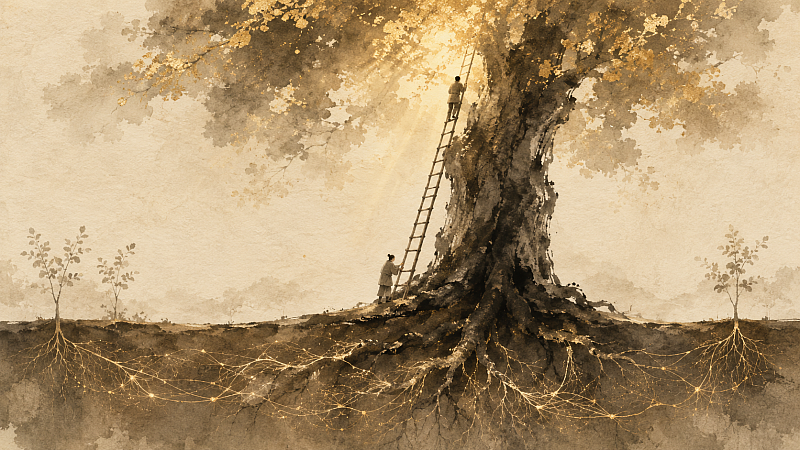
That is why laddership and being held are not two teachings but one, seen from both sides: laddership is the art of holding others up; held is the grace of letting a field hold you. And the loop is regenerative — climbers who rise on ladders tend the soil that raises more ladders. In our fellowship's language, it is the last season of the journey, when the name is barely a name at all: not Shunya Fellow, not Field Fellow — simply a ladder. The final promotion is to go unnamed.
Leadership asks: how high can I climb?
Laddership asks: who rises if I hold still?
This page is a small clearing. The forest — the full framework, the counter-curriculum, field reports from hundreds of circles and pods since 2014 — lives with the ServiceSpace commons.
And if you sense you might be a ladder in the making — raise a hand.